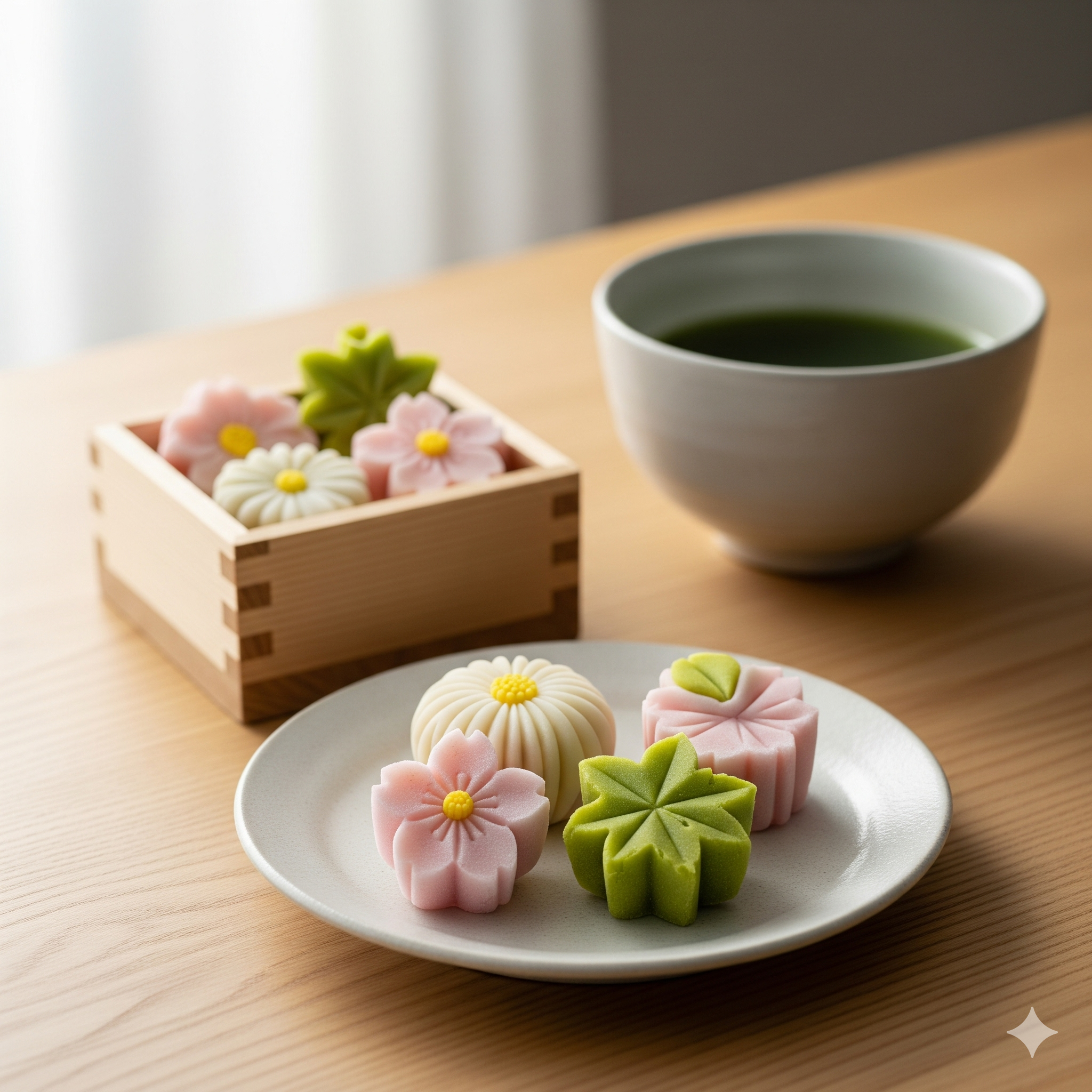
In the world of wagashi, Japan’s traditional confections, there are three primary categories defined by their moisture content. While namagashi (fresh sweets) capture the imagination with their soft, ephemeral beauty, and han’namagashi (semi-fresh) offer a balance, it is Higashi (干菓子) that stands as a testament to understated elegance and masterful craftsmanship. These “dry confections,” with a moisture content of less than 10%, are not merely sweets but miniature sculptures, designed to be admired for their beauty as much as they are enjoyed for their taste.
This article delves into the quiet sophistication of Higashi, exploring the simple ingredients that make them, the intricate process of their creation, and their profound cultural role, particularly in the traditional Japanese tea ceremony.
What Exactly is Higashi? A Brief Introduction
Higashi are a class of dry, molded sweets that are often hard or brittle but are designed to melt and dissolve quickly in the mouth. Unlike other Japanese sweets that might be chewy or soft, the texture of Higashi is its defining characteristic. The name Higashi literally translates to “dried sweets,” and this low moisture content gives them a long shelf life, making them ideal for gifts and ceremonial use.
Their charm lies in their simplicity. They are not overpoweringly sweet, but rather provide a light, clean flavor that serves as a perfect complement to the bitter, earthy taste of powdered green tea (matcha).
The Core Ingredients and Their Role
The foundation of most Higashi is surprisingly simple, yet the quality of these ingredients is paramount.
- Wasanbon (和三盆): The highest-grade Higashi are made almost exclusively from Wasanbon, a type of fine-grained sugar produced in specific regions of Japan. Wasanbon has a subtle, elegant sweetness and a unique texture that allows it to dissolve effortlessly on the tongue, without the lingering cloying taste of regular sugar. It is this ingredient that gives high-end Higashi their refined and delicate flavor.
- Roasted Flours: Other types of Higashi may use powdered rice flour (joshinko), glutinous rice flour (mochiko), or roasted soybean flour (kinako) as a base. These flours are combined with sugar and water to create a mixture that can be pressed into molds.
- Natural Colorings: To achieve their vibrant and symbolic colors, Higashi artisans use natural ingredients like matcha for green, cherry blossoms for pink, or charcoal for black.
The Art of the Mold: How Higashi is Made
The creation of Higashi is a meticulous and time-honored process that is a craft in its own right. The most crucial tool is the wooden mold, known as a kashigata (菓子型). These molds are often hand-carved from wood, a skill passed down through generations. The designs are incredibly detailed, ranging from simple geometric shapes to intricate representations of flowers, leaves, animals, and seasonal motifs.
The process involves:
- Mixing: The powdered ingredients are mixed with a small amount of water until they have the consistency of damp sand.
- Pressing: The mixture is pressed firmly into the cavities of the carved wooden molds, ensuring every detail is captured.
- Tapping: With a swift and gentle tap of a wooden mallet, the finished piece of Higashi is released from the mold, a testament to the precision of the artisan.
A Gallery of Shapes and Meanings
The beauty of Higashi lies in their powerful symbolism. Their designs are a direct reflection of the seasons, poetry, and a deep reverence for nature. A single tray of Higashi can tell a story of a landscape, a fleeting moment, or a feeling.
- Spring: Cherry blossoms, plum blossoms, and butterflies symbolize renewal and new beginnings.
- Summer: Designs of hydrangeas, folding fans, or miniature fireworks capture the warmth and vibrance of the season.
- Autumn: Maple leaves, chrysanthemums, and pine cones represent the changing colors and the serenity of the season.
- Winter: Snowflakes, camellia flowers, and pine branches symbolize purity and endurance.
The Role of Higashi in Japanese Culture
Higashi is far more than a simple sweet; it is an integral part of Japanese cultural and social rituals.
The Tea Ceremony (Chanoyu)
Higashi holds a place of honor as the sweet served with usucha (thin tea) during the traditional tea ceremony. The act of enjoying Higashi is a sensory experience. The guest first admires the beauty of the sweet, often placed on a special dish. They then place it in their mouth, allowing its delicate texture to dissolve, which prepares the palate for the sharp, slightly bitter taste of the matcha that follows. This sequence—the sweet to the bitter—creates a perfect harmony that is central to the ceremony’s philosophy.
Celebrations and Gifts
Due to their elegance, beautiful packaging, and long shelf life, Higashi are a popular choice for omiyage (souvenirs) and formal gifts. They are often given as a token of appreciation, a symbol of good luck, or a celebratory gesture for special occasions. Many regional varieties of Higashi are famous as tourist souvenirs, representing the unique culture and traditions of a specific area.
The Types of Higashi
While Higashi is a broad category, there are a few notable types.
- Rakugan (落雁): This is the most common form of Higashi, made from powdered rice flour mixed with sugar and pressed into molds. Rakugan can be found in a vast array of colors and shapes and are a staple of many wagashi-ya.
- Kohakutō (琥珀糖): Known as “amber sugar,” this is a type of crystalized jelly made from agar-agar and sugar. The exterior hardens into a delicate crunch, while the inside remains a soft, jelly-like consistency. While they are a form of Higashi, their texture is unique.
- Bolo: Small, baked cookies that are simple and melt on the tongue. They are a beloved treat for children and are also classified as Higashi.
Frequently Asked Questions
What is the difference between Higashi and Namagashi?
The primary difference is moisture content. Higashi are “dry” sweets with a low moisture content (less than 10%), giving them a hard, brittle texture and a long shelf life. Namagashi are “fresh” sweets with a high moisture content (over 30%), giving them a soft, delicate texture and a very short shelf life.
What do Higashi taste like?
Higashi have a delicate, subtle sweetness. Their flavor is not intense. The experience is more about the unique texture—the way they crumble and dissolve in your mouth, leaving a clean, light sweetness that beautifully prepares the palate for a drink like matcha.
How are Higashi served?
Higashi are traditionally served on a small plate or a piece of special paper and eaten with the fingers or a small bamboo pick. They are almost always served with a bowl of usucha (thin powdered green tea).
Can I find Higashi outside of Japan?
Yes, as Japanese cuisine and culture have grown in popularity, Higashi can be found in some specialized Japanese grocery stores, tea shops, and online retailers that import Japanese goods.
Leave a Reply